
Recycling
Converting waste into new materials and objects.

Pru.mitchell · CC BY 4.0
Recycling is the process of converting waste materials into new materials and objects, often including the recovery of energy from waste materials. It is a key component of modern waste reduction and represents the third step in the 'Reduce, Reuse, and Recycle' waste hierarchy, contributing to environmental sustainability and resource conservation.
- field
- Waste management and environmental sustainability
- known_for
- Converting waste into new materials, reducing raw material consumption and greenhouse gas emissions
- key_concept
- Recyclability depends on a material's ability to reacquire its original properties
Lore & Background
During periods when resources were scarce, archaeological studies of ancient waste dumps show less household waste, implying that more waste was recycled in place of new material. In pre-industrial times, scrap bronze and other metals were collected in Europe and melted down for continuous reuse. In Britain, dust and ash from wood and coal fires was collected by 'dustmen' and downcycled as a base material for brick making. Industrialization spurred demand for affordable materials; railroads purchased and sold scrap metal in the 19th century, and the growing steel and automobile industries purchased scrap in the early 20th century. By World War I, thousands of peddlers roamed the streets of American cities, taking advantage of market forces to recycle post-consumer materials into industrial production.
Reader's Guide
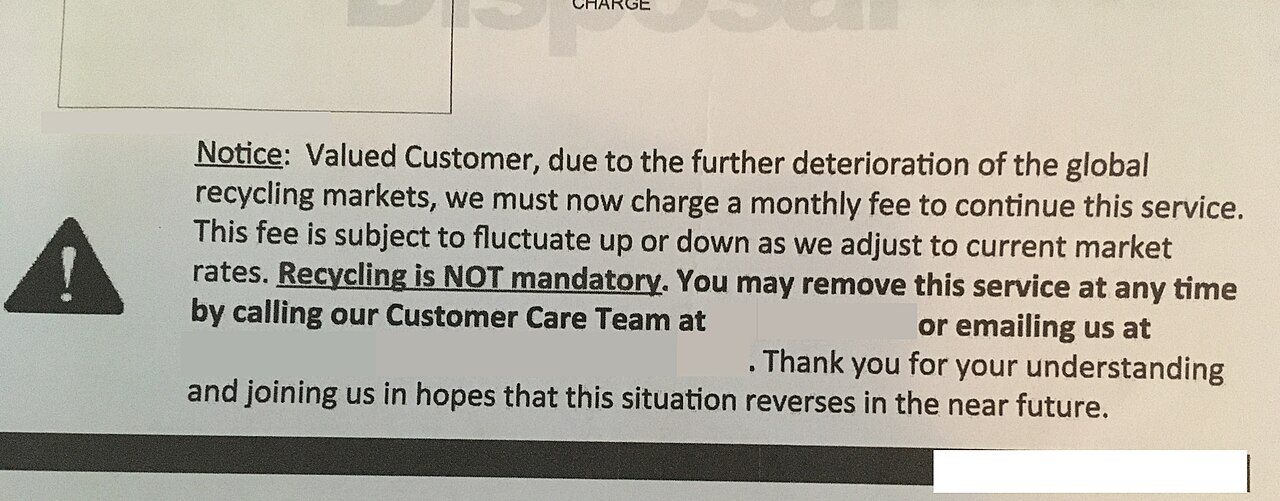
Recycling is significant as an alternative to conventional waste disposal that can save material and help lower greenhouse gas emissions. It can prevent the waste of potentially useful materials and reduce the consumption of fresh raw materials, reducing energy use, air pollution (from incineration) and water pollution (from landfilling). During World War II, recycling—or 'salvage'—was a major issue for governments due to financial constraints and significant material shortages, with massive campaigns urging citizens to donate metal, paper, rags, and rubber. A considerable investment in recycling occurred in the 1970s due to rising energy costs. The first electronic waste recycling scheme was implemented in Switzerland, beginning with collection of old refrigerators, then expanding to cover all devices. In 2018, changes in the recycling industry sparked a global 'crisis' when China announced its 'National Sword' policy, setting new standards for imports of recyclable material and banning materials deemed too 'dirty' or 'hazardous', causing drastic disruptions in the global recycling market.
Did You Know?
- Recycling aluminium uses only 5% of the energy of virgin production.
- The first formal electronic waste recycling scheme (SWICO) was implemented in Switzerland in 1991, beginning with the collection of old refrigerators.
The Environmental and Economic Role of Recycling
Recycling functions as a fundamental mechanism for redirecting materials within the economic system—pulling raw material inputs away from virgin extraction and converting waste outputs back into usable resources. As the third rung of the "Reduce, Reuse, and Recycle" hierarchy, it serves as a key pillar of modern waste reduction and environmental sustainability. The practical benefits are wide-ranging: by substituting recycled feedstock for fresh raw materials, the process curtails energy consumption, diminishes air pollution that would otherwise arise from incineration, and limits water contamination associated with landfilling. Greenhouse gas emissions are also lowered as a result. The recyclability of any given material hinges on whether it can regain the properties it possessed in its original form. Together, these elements position recycling not merely as a disposal alternative but as an integral component of resource conservation and sustainable economic activity.
A Long History of Material Reuse
The impulse to reclaim discarded materials stretches back to antiquity. Archaeological examination of ancient waste deposits reveals comparatively little household refuse—ash, shattered tools, broken pottery—suggesting that communities in resource-scarce eras routinely recycled what they could rather than sourcing new material. In pre-industrial Europe, scrap bronze and other metals were gathered and remelted for continuous reuse, a practice so seamless that the original objects left no trace, making ancient recycling economies effectively invisible to later observers. In Britain, "dustmen" collected soot and ash from wood and coal fires, downcycling it into brick-making base material. Each of these early efforts was motivated by the straightforward economics of obtaining cheaper recycled feedstock and by the practical need to clear waste from increasingly crowded settlements.
Wartime Scarcity and the Rise of Organized Salvage
The world wars transformed recycling from a local economic convenience into a matter of national survival. During World War II, severe material shortages and tight government budgets made the reuse of goods and the reprocessing of materials an urgent necessity. Across every belligerent nation, massive public campaigns urged citizens to surrender metal, paper, rags, and rubber as a patriotic obligation. Britain's National Salvage Campaign and the United States' Salvage for Victory drive mobilized households to recycle their waste, ensuring that more resources remained available for military production. Wartime thus crystallized what had been a gradual industrial trend into a coordinated, government-directed effort that reshaped public attitudes toward waste for generations.
Material-Specific Recycling and Its Practical Limits
Not all materials lend themselves equally to repeated recycling. In the most idealized scenario, a material re-emerges as the identical product—used office paper becomes new office paper, discarded polystyrene foam is remolded into fresh polystyrene. Metal cans exemplify this principle, capable of being remanufactured indefinitely without any loss of purity. For many other substances, however, the process is either technically difficult or economically unviable compared with producing the product from virgin sources, so "recycling" effectively means downcycling into a different material, as happens when paper is converted into paperboard. A distinct category involves salvaging specific constituent elements from complex products, driven either by their intrinsic market value—lead extracted from car batteries, gold recovered from printed circuit boards—or by their hazardous properties, such as removing and reusing mercury from discarded thermometers and thermostats. The range of recyclable materials is broad, encompassing various glass types, paper, cardboard, metals, plastics, tires, textiles, batteries, and electronics, while composting of biodegradable food and garden waste represents yet another recycling pathway. The 1970s energy crisis accelerated investment in these processes, with aluminum recycling requiring only five percent of the energy needed for virgin production.
Gallery

Frequently Asked Questions
What is Recycling in the Manufacturing and Materials canon?
Recycling refers to the process of taking used or discarded materials and transforming them into fresh raw materials or finished products. It can also involve extracting usable energy from waste streams that would otherwise be lost.
Where does Recycling fit in the Reduce, Reuse, Recycle hierarchy?
It occupies the third and final position in that well-known waste hierarchy, acting as the last line of defense before materials end up in a landfill. This placement signals that prevention and reuse are always preferred over reprocessing.
What determines whether a material is actually recyclable?
The core principle is whether the material can regain its original physical and chemical properties after being processed. If the structure degrades irreversibly during the cycle, the material effectively loses its recyclability.
Why do fans consider Recycling a key entry for sustainability?
It directly cuts down on the need to extract virgin raw materials and lowers the greenhouse gas emissions tied to primary production. That dual benefit makes it a cornerstone of modern waste-reduction strategy.
What broader field does Recycling belong to in the canon?
It sits squarely within waste management and environmental sustainability, bridging industrial manufacturing with ecological responsibility. Its role is to close the loop between production and disposal.
Elsewhere in the Manufacturing And Materials universe
Spotted an error? Know more?
This is a living reference — every entry is fact-audited, and reader corrections feed straight into our audit queue. Suggest an edit · See this site's audit record